How to Automate Rental Income Distribution in Tokenized Real Estate
9 min read
Summary
Rental income in tokenized property can reach every holder without manual work once the payout engine is set up right. Rent is collected, the system records who holds tokens on a set date, each share is worked out by ownership, and the money lands in wallets as stablecoin. The parts that decide whether it runs clean are the record date, the payout method, and the currency.
When a property is tokenized, it is split into many small shares. Each share is a token, and each token sits in an investor’s wallet. One building can have a few hundred owners this way.
Every month that building earns rent. That rent has to be split among all those owners and sent to their wallets. The more owners there are, the harder this gets to do by hand.
This is where automation comes in. A payout engine collects the rent, works out who owns what, splits it, and sends each share. Once it is set up, every holder is paid on time, cycle after cycle.
This guide shows how to automate rental income distribution, from the first rent payment to the final wallet.
What Automated Rental Distribution
It helps to split one idea into two parts.
The token is proof of a share. It sits in a holder’s wallet and records how much of the property they own. On its own, it moves no money.
Property tokens often run on a permissioned standard made for regulated assets, like ERC-1400 or ERC-3643, rather than the ERC-20 standard used for open crypto. That lets the token carry transfer rules and holder checks inside it.
The payout engine is the part that pays. It reads ownership from the tokens, works out each share, and sends the rent. This is the piece that gets automated.
It is easy to assume the token pays the rent. It does not. The token holds the claim. A smart contract and a payout flow do the work.
How Rent Reaches Token Holders
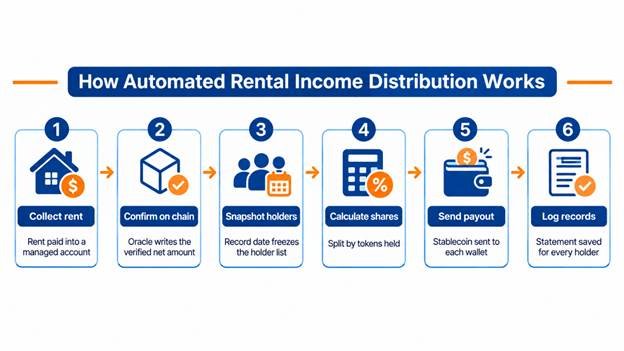
Here is the full path rent takes, from a tenant’s payment to a holder’s wallet. Most automated rental distribution systems run some version of these six steps.
- Rent is collected. The tenant pays into a managed account. At this stage the money is usually ordinary currency, not crypto.
- The income is reconciled and confirmed on chain. The platform checks what came in against what was due, then takes out costs like management fees, maintenance, and reserves. An oracle service, such as Chainlink, writes that confirmed net figure on chain, so the contract pays from a verified number rather than a claim.
- The holder list is snapshotted. On a set date, the system records who holds how many tokens. This frozen list decides who gets paid this cycle.
- Each share is calculated. The net rent is split by token count. Hold two percent of the tokens, receive two percent of the net rent. The split is proportional and the contract does the arithmetic.
- The payout is sent. The smart contract moves each share to holder wallets. Most engines pay in stablecoin, so the value holds steady between cycles.
- The record is logged. Every payout is written down per holder, ready for statements and reporting.
The first two steps happen off chain, in the world of bank accounts and property managers. The last four happen on chain, where code runs the same way every time. Getting the handoff between those two worlds right is the heart of the job.
Who Gets Paid When Tokens Are Sold
Tokens do not sit still. They trade. Someone can buy on the first of the month and sell on the twentieth. So who gets that month’s rent?
The answer is the record date. The system picks a moment and takes a snapshot of every holder. Whoever holds tokens at that moment is paid for that cycle.
A snapshot matters because ownership keeps shifting. Without a fixed point, two people could claim the same share, or a seller could be paid for tokens they no longer hold.
Most engines tie the record date to a block on the chain. The blockchain already timestamps every transfer, so the holder list at that block is exact. No manual check, no dispute.
Set the record date, publish it, and holders know the rule before they buy or sell.
Two Ways Rent is Sent to Wallets
There are two ways to get rent into holder wallets. The choice affects cost and reliability.
Push means the contract sends every share out in one run. Holders do nothing. It feels effortless, but it costs more in network fees, and one failed transfer can stall the whole batch.
Pull means each holder claims their share when they want it. The contract keeps a running record of what they are owed. Fees drop, and one bad address cannot block anyone else.
For a small group of holders, push works fine. As the holder count climbs into the hundreds or thousands, pull tends to scale better and cost less.
Some engines mix both. They push to active holders and let the rest claim. The right call rests on holder numbers, network fees, and how hands off you want the payout to feel.
What Currency Holders Are Paid In
Rent has to arrive as something holders can use. Most engines pay in stablecoin, since its value tracks a currency and does not swing the way other crypto does.
There are a few routes.
A stablecoin pegged to a major currency is the common choice. It is widely held, easy to move, and liquid on most networks.
A stablecoin pegged to a local currency suits holders who think in that currency. This route carries a catch. A local currency stablecoin usually needs a licensed issuer, and that issuer often answers to a different regulator than the one that cleared the property token. Two approvals, not one.
A direct bank transfer skips crypto at the final step. It adds cost and delay, and it needs off chain handling, but some holders would rather see cash in a bank.
One more point. Holders need a way back to cash. A payout in stablecoin only helps if there is a clear path to redeem it. Plan the exit route, not just the payout.
What Happens When Rent Does Not Arrive
Rent does not always land in full. A tenant pays late. A unit sits empty. The payout engine needs a rule for each case, set before it happens.
Late rent gets a grace period. The system waits a set number of days before it treats the payment as missed. If it clears in time, the cycle runs as normal.
A reserve pool smooths the gaps. A slice of each strong month is held back. When a month falls short, the reserve tops up the payout so holders still receive something steady.
An empty unit means less rent to share. The engine prorates. It splits whatever came in across holders by their share, and records the shortfall so the numbers stay honest.
Holders should know these rules up front. A payout that drops without a reason reads as a fault. A payout that drops with a logged reason reads as a system doing its job.
Keeping Records Straight: Statements and Reporting
Every payout should leave a trail. Not for its own sake, but because holders need it.
The engine writes a statement for each holder each cycle. It shows the gross rent, the costs taken out, and the net amount received. The blockchain already logs the transfer, so each statement ties back to an on chain record anyone can check.
This counts because holders may sit in many different places, each with their own reporting duty at home. The platform does not file for them. It hands them clean figures so they can.
Good records protect the operator too. If a holder questions a payout, the statement and the on chain entry settle it in minutes.
Build Your Own System or Use a Ready Platform
There are two ways to get a payout engine. Build one, or run one that already works.
Building from scratch gives full control. You own the code and shape every rule. It also means a longer timeline, a larger budget, and a team that can maintain smart contracts well after launch. Strong Real Estate Platform development solutions matter most here, because an engine that handles other people’s money cannot cut corners.
A ready platform shortens the path. White label real estate tokenization platform solutions give you a tested payout engine you can brand as your own and launch in weeks rather than quarters. You trade some control for speed and a lower upfront cost.
The honest answer rests on scale and timeline. A one off project may not justify a full build. A long roadmap across many properties often does. This is where RWA tokenization platform Development services help, by weighing that tradeoff against your real plans before a line of code is written.
Getting Your Distribution Engine Built Right
Rental distribution is less about the token and more about the engine behind it. That engine has to be correct, audited, and built to move real money on a schedule.
Minddeft Technologies Pvt Ltd has worked in this space since 2015, backed by its publicly listed parent, DEV IT. That backing counts when the job involves custody of funds and contracts that run for years.
This is not new ground for the team. Minddeft Technologies Pvt Ltd has built an automated rental payment system over blockchain for a property rental venture, using smart contracts to run the rent agreements and move payments without a bank in the middle. It has also built a stablecoin with on chain liquidity reserves, the kind of payout currency this guide describes.
That mix of build and audit under one roof makes Minddeft a strong fit for enterprise real world asset work, where both sides have to hold up. Its Real Estate Tokenization Development services cover the full payout flow, from the record date to the final transfer. The starting point is a conversation, not a pitch. The team maps your properties, your holder base, and your payout plan, then points to the right path. That groundwork rests on years of blockchain development solutions across tokenization, smart contracts, and audits.
Hire Industry Experts
Hire Us NowGet started with Minddeft
today
Contact Us NowFrequently Asked Questions
It varies by platform. Payouts run anywhere from daily to monthly, with monthly common for residential property and quarterly for commercial leases. The schedule is fixed in the offering terms before you invest.
Most platforms pay in a stablecoin pegged to a major currency, so the value stays steady. Some offer a local currency stablecoin or a bank transfer. Check what each platform supports before you buy.
Payment follows the record date. If you hold tokens at the snapshot, you receive that cycle’s rent. Sell before it, and the buyer is paid instead.
Usually less, and sometimes nothing for that cycle. Many platforms hold a reserve pool to smooth short months. The exact rule should be stated in the offering terms.
Yes. The contract moves real money, so an audit checks it for bugs and exploits before launch. Running an unaudited payout contract puts holder funds at risk.

MINDDEFT TECHNOLOGIES PVT LTD
10, Aaryans Corporate Park,
Thaltej-Shilaj Rd, Thaltej,
Ahmedabad - 380059, Gujarat (IN)